Making Conservatives Cringe Since 1977
I'm not Liberal, I'm paying attention.31 January 2006
Sweet Jesus' General


Think this'll come up during the State of the Union?
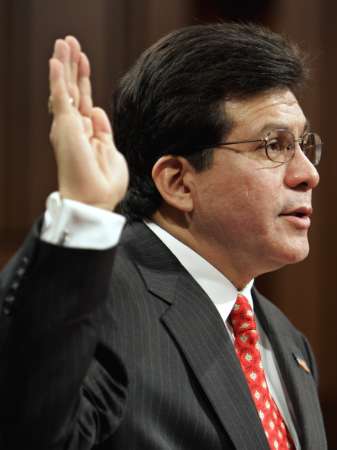 Gonzales Is Challenged on Wiretaps
Feingold Says Attorney General Misled Senators in Hearings
By Carol D. Leonnig
Washington Post Staff Writer
Tuesday, January 31, 2006;
Page A07
Gonzales Is Challenged on Wiretaps
Feingold Says Attorney General Misled Senators in Hearings
By Carol D. Leonnig
Washington Post Staff Writer
Tuesday, January 31, 2006;
Page A07
Sen. Russell Feingold (D-Wis.) charged yesterday that Attorney General Alberto R. Gonzales misled the Senate during his confirmation hearing a year ago when he appeared to try to avoid answering a question about whether the president could authorize warrantless wiretapping of U.S. citizens.
. . . Gonzales said “it is not the policy or the agenda of this president to authorize actions that would be in contravention of our criminal statutes.” In fact, he personally approved Bush’s warrantless domestic spying program, in contravention of a criminal statute. We have the full transcript of the Feingold/Gonzales exchange posted. In addition to Gonzales, former NSA director Michael Hayden and President Bush also made false statements relating to warrantless domestic surveillance.
30 January 2006
Tough Talk
 Wow, you really flamed NavySwan up didn't you RV?! Problem is..., far from shutting any critics down, the Justice Department Memo has opened up more questions than it has answered. The same with General Hayden's defense from last week:
 According to Hayden, the reason the President wanted to bypass FISA was because FISA requires a showing of "probable cause" in order to obtain a FISA warrant for eavesdropping on telephone conversations, and the President believed that standard was too burdensome.This is an argument that falls flat on its face when you consider (among all the other reasons) the Administration would not support Senator DeWine's bill, which would have eliminated the "probable cause" barrier because it believed it would be unconstitutional. The reason why you're worked up, and NavySwan is worked up, and I as well, is because we love our country and would not see it perish. Here, however, one of the very things that makes our country great, the rule of law, specifically that which is embodied in the Fourth Amendment, is in jeopardy. I for one do not take that lightly, and I'm afraid that the situation will be solved in a political manner instead of what the law would proscribe:
Section 1809 of FISA, expressly provides that "[a] person is guilty of an offense if he intentionally - (1) engages in electronic surveillance under color of law except as authorized by statute. . . ." And Section 2511(2)(f) provides that FISA "shall be the exclusive means by which electronic surveillance . . . may be conducted."
 Would you give all this up for partisan politics?
Or would you err on the side of caution, and for liberty?
Would you give all this up for partisan politics?
Or would you err on the side of caution, and for liberty?
School days.
28 January 2006
In the Valley of the Shadow

A true Patriot
 All you need to do in order to support the troops is put a bumper sticker on your car. No, really, straight from the mouth of
 27 January 2006
Didn't he say the same about Ken Lay at first?
 -You are forgiven for that whole screwing the Chinese People thing, Google.
Democracy on the March!
 As if the time hasn’t already passed for the U.S. to radically rethink it’s foreign policy, we can now add Palestine to the list above. If these parodies of the democratic process aren’t signal enough, what will be? The rise of radical Islam is directly tied to the oppressive governments that we have supported all these years. Islamist militancy is a symptom of the alienation the people of the Middle East feel when they are left out of the governing process. Far from being any kind of fan of Hamas, I hope that their new position of “being inside the tent pissing out,” rather than, “being outside the tent pissing in,” is not derailed by American and Israeli, “Shout shrilly and carry a big stick,” diplomacy.
 26 January 2006
This is not a Democracy, it a Cheerocracy.
They were for FISA before they were against it...
by kos
Wed Jan 25, 2006 at 09:15:47 PM PDT
The story doesn't note it, but the argument the Justice Department used against expanding FISA to cover non-US citizens inside the U.S. was -- get this -- that it was probably unconstitutional.
Tuesday, January 24, 2006
The Administration's new FISA defense is factually false
In light of Gen. Hayden's new claim yesterday that the reason the Bush Administration decided to eavesdrop outside of FISA is because the "probable cause" standard for obtaining a FISA warrant was too onerous (and prevented them from obtaining warrants they needed to eavesdrop), there is a fact which I have not seen discussed anywhere but which now appears extremely significant, at least to me. In June, 2002, Republican Sen. Michael DeWine of Ohio introduced legislation (S. 2659) which would have eliminated the exact barrier to FISA which Gen. Hayden yesterday said is what necessitated the Administration bypassing FISA. Specifically, DeWine's legislation proposed:to amend the Foreign Intelligence Surveillance Act of 1978 to modify the standard of proof for issuance of orders regarding non-United States persons from probable cause to reasonable suspicion. . . .In other words, DeWine's bill, had it become law, would have eliminated the "probable cause" barrier (at least for non-U.S. persons) which the Administration is now pointing to as the reason why it had to circumvent FISA.
The Department of Justice has been studying Sen. DeWine's proposed legislation. Because the proposed change raises both significant legal and practical issues, the Administration at this time is not prepared to support it.
The Department's Office of Legal Counsel is analyzing relevant Supreme Court precedent to determine whether a "reasonable suspicion" standard for electronic surveillance and physical searches would, in the FISA context, pass constitutional muster. The issue is not clear cut, and the review process must be thorough because of what is at stake, namely, our ability to conduct investigations that are vital to protecting national security. If we err in our analysis and courts were ultimately to find a "reasonable suspicion" standard unconstitutional, we could potentially put at risk ongoing investigations and prosecutions.
25 January 2006
My names Bill Frist, and I'm a card carrying whiner
For a fellow veteran
24 January 2006
Intercalaris
23 January 2006
GCG

21 January 2006
The concept of Drafting
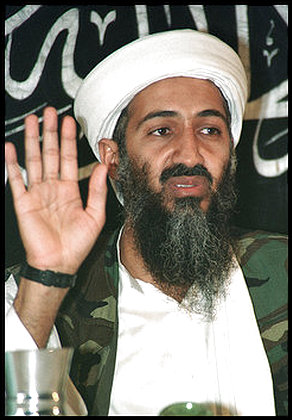 Who was he?
I just finished up an article by Richard A. Clarke at The Washington Post.com in which he reviews Peter Bergen's book on Osama bin Laden. Clarke gives a decent overview, running throught the strengths and weaknesses, and relaying the feel of the book. One thing jumped out at me, lets see if it jumps out at you as well:
Who was he?
I just finished up an article by Richard A. Clarke at The Washington Post.com in which he reviews Peter Bergen's book on Osama bin Laden. Clarke gives a decent overview, running throught the strengths and weaknesses, and relaying the feel of the book. One thing jumped out at me, lets see if it jumps out at you as well:
The result is a detailed, well-researched narrative that persuasively answers dozens of questions that are still painfully relevant today: Did the CIA give bin Laden his start in Afghanistan in the 1980s jihad against the Soviets? (No, the CIA's aid went directly to Afghan mujaheddin fighting the occupiers, not to Arab outsiders like bin Laden.) Did the Pentagon let him slip away in 2001? (Yes, by only belatedly sending U.S. troops to Tora Bora, where Bergen -- despite Bush administration claims -- confirms that bin Laden was cornered.) Is bin Laden behind Abu Musab Zarqawi's insurgent attacks in Iraq? (No, Zarqawi's group was always a separate, Jordanian-based organization, not one that takes orders from bin Laden.) Did Saddam Hussein and bin Laden work together? (No, the fanatically religious bin Laden loathed the secular Iraqi tyrant.)Go ahead and Google, "Did the CIA give bin Laden his start in Afghanistan in the 1980s jihad against the Soviets?" You'll find that among the other established facts, about bin Laden's relationship with Zarqawi and Saddam, Bergan's implication (via Clarke) that bin Laden had no connection whatso ever with the CIA is on less solid ground. I'm not saying that the CIA created bin Laden, and I'm not saying that Google should be the end all, be all of research, but the results are interesting. Items of intrest... Exhibit A: Thursday, June 10th, 2004 Ghost Wars: How Reagan Armed the Mujahadeen in Afghanistan
During Reagan's 8 years in power, the CIA secretly sent billions of dollars of military aid to the mujahedeen in Afghanistan in a US-supported jihad against the Soviet Union. We take a look at America's role in Afghanistan that led to the rise of Osama bin Laden's al Qaeda with Pulitzer prize-winning journalist Steve Coll, author of Ghost Wars: The Secret History of the CIA, Afghanistan, and Bin Laden, from the Soviet Invasion to September 10, 2001. [Includes transcript]
 Exhibit A-1:
Abolish the CIA!
By Chalmers Johnson TomDispatch.com
Exhibit A-1:
Abolish the CIA!
By Chalmers Johnson TomDispatch.com Friday 05 November 2004
This piece is adapted from and printed thanks to the permission of the London Review of Books where, in slightly altered form, it appeared on 21 October 2004, pp. 25-28.
"Ghost Wars: The Secret History of the CIA, Afghanistan and bin Laden, from the Soviet Invasion to 10 September 2001", by Steve Coll, New York: Penguin, 2004, 695 pp, $29.95.
Excerpt-
Funding the Fundamentalists
The CIA had no intricate strategy for the war it was unleashing in Afghanistan. Howard Hart, the agency's representative in the Pakistani capital, told Coll that he understood his orders as: "You're a young man; here's your bag of money, go raise hell. Don't fuck it up, just go out there and kill Soviets." These orders came from a most peculiar American. William Casey, the CIA's director from January 1981 to January 1987 . . . Casey knew next to nothing about Islamic fundamentalism or the grievances of Middle Eastern nations against Western imperialism. He saw political Islam and the Catholic Church as natural allies in the counter-strategy of covert action to thwart Soviet imperialism. He believed that the USSR was trying to strike at the U.S. in Central America and in the oil-producing states of the Middle East. He supported Islam as a counter to the Soviet Union's atheism, and Coll suggests that he sometimes conflated lay Catholic organizations such as Opus Dei with the Muslim Brotherhood, the Egyptian extremist organization, of which Ayman al-Zawahiri, Osama bin Laden's chief lieutenant, was a passionate member. The Muslim Brotherhood's branch in Pakistan, the Jamaat-e-Islami, was strongly backed by the Pakistani army, and Coll writes that Casey, more than any other American, was responsible for welding the alliance of the CIA, Saudi intelligence, and the army of General Mohammed Zia-ul-Haq, Pakistan's military dictator from 1977 to 1988. On the suggestion of the Pakistani Inter-Services Intelligence (ISI) organization, Casey went so far as to print thousands of copies of the Koran, which he shipped to the Afghan frontier for distribution in Afghanistan and Soviet Uzbekistan. He also fomented, without presidential authority, Muslim attacks inside the USSR . . .Fair-Weather Friends
Enter bin Laden and the SaudisA co-operative agreement between the U.S. and Pakistan was anything but natural or based on mutual interests. Only two weeks after radical students seized the American Embassy in Tehran on November 5, 1979, a similar group of Islamic radicals burned to the ground the American Embassy in Islamabad as Zia's troops stood idly by. But the US was willing to overlook almost anything the Pakistani dictator did in order to keep him committed to the anti-Soviet jihad. After the Soviet invasion, Brzezinski wrote to Carter: "This will require a review of our policy toward Pakistan, more guarantees to it, more arms aid, and, alas, a decision that our security policy toward Pakistan cannot be dictated by our non-proliferation policy." History will record whether Brzezinski made an intelligent decision in giving a green light to Pakistan's development of nuclear weapons in return for assisting the anti-Soviet insurgency.
From the beginning, Zia demanded that all weapons and aid for the Afghans from whatever source pass through ISI hands. The CIA was delighted to agree. Zia feared above all that Pakistan would be squeezed between a Soviet-dominated Afghanistan and a hostile India. He also had to guard against a Pashtun independence movement that, if successful, would break up Pakistan. In other words, he backed the Islamic militants in Afghanistan and Pakistan on religious grounds but was quite prepared to use them strategically. In doing so, he laid the foundations for Pakistan's anti-Indian insurgency in Kashmir in the 1990s.
From the moment agency money and weapons started to flow to the mujahidin in late 1979, Saudi Arabia matched the U.S. payments dollar for dollar. They also bypassed the ISI and supplied funds directly to the groups in Afghanistan they favored, including the one led by their own pious young millionaire, Osama bin Laden. According to Milton Bearden, private Saudi and Arab funding of up to $25 million a month flowed to Afghan Islamist armies. Equally important, Pakistan trained between 16,000 and 18,000 fresh Muslim recruits on the Afghan frontier every year, and another 6,500 or so were instructed by Afghans inside the country beyond ISI control. Most of these eventually joined bin Laden's private army of 35,000 "Arab Afghans." . . . the CIA made almost no effort to recruit paid agents or collect intelligence. The result was that Saudi Arabia worked continuously to enlarge the ISI's proxy jihad forces in both Afghanistan and Kashmir, and the Saudi Ministry for the Propagation of Virtue and the Prevention of Vice, the kingdom's religious police, tutored and supported the Taliban's own Islamic police force.
"While the charges that the CIA was responsible for the rise of the Afghan Arabs might make good copy, they don't make good history. The truth is more complicated, tinged with varying shades of gray. The United States wanted to be able to deny that the CIA was funding the Afghan war, so its support was funneled through Pakistan's Inter Services Intelligence agency (ISI). ISI in turn made the decisions about which Afghan factions to arm and train, tending to favor the most Islamist and pro-Pakistan. The Afghan Arabs generally fought alongside those factions, which is how the charge arose that they were creatures of the CIA. [Holy War, Inc.: Inside the Secret World of Osama bin Laden (New York: The Free Press, 2001), pp. 64-66.]
The summary seen at usinfo.state.gov:
• U.S. covert aid went to the Afghans, not to the "Afghan Arabs."
• The "Afghan Arabs" were funded by Arab sources, not by the United States.
• United States never had "any relationship whatsoever" with Osama bin Laden.
• The Soviet invasion of Afghanistan, Arab backing for the "Afghan Arabs," and bin Laden's own decisions "created" Osama bin Laden and al Qaeda, not the United States.
What we did do was: * Facilitate Arab funding for the fight against the Russians * Use the Pakistani intelligence services as intermediaries far more that was prudent * Tolerate the modest number of "Arab fighters" who joined the cause because we assumed that while they were not militarily significant, they were somehow a necessary part of keeping the flow of private Arab funding at substantial levels.I'm not going to let Clarke slip by with what he said anymore than Blackton's commentors:
20 January 2006
Fridays Top Ten
19 January 2006
Who speaks for me...
 Blunt Instrument
Only at TNR Online | Post date 01.19.06
Blunt Instrument
Only at TNR Online | Post date 01.19.06 It looked like a wedding. The setting was the majestic Great Hall of the Library of Congress, an absurdly ornate cavern of white marble, grand staircases, brass inlayed floors, stained glass sky lights, and 75-feet high ceilings. Reporters were warned not to block one staircase landing as it was being used for the "procession." And sure enough, as a treacly orchestral soundtrack echoed through the room, Harry Reid and Nancy Pelosi, followed by dozens of their fellow Democrats, slow-walked two-by-two down the aisle and assembled on a makeshift stage....

"When you look at the way the House of Representatives has been run, it has been run like a plantation, and you know what I'm talking about." - Hillary Clinton---". . . the Executive Branch of our government has been caught eavesdropping on huge numbers of American citizens and has brazenly declared that it has the unilateral right to continue without regard to the established law enacted by Congress to prevent such abuses." - Al Gore


DOWNLOAD - .WMV DOWNLOAD - .MP4
1984 + Catch 22 = 2006

". . . Oceania will not let up in the peace conflict on terror despite the threats on the tape, said Inner Party Headquarters press secretary Scott McClellan."-from our friends at the Agitprop News Agency.
18 January 2006
Cowboys and Indians
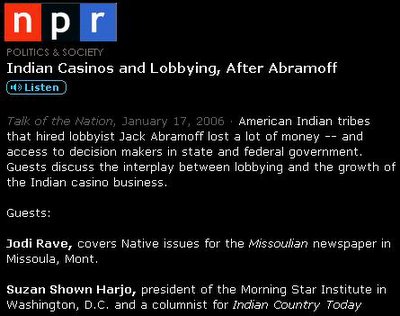
FYI: Howard Stern Shows Constraint, Dumps Content Was Howard Stern's Sirius Show Pirated? Howard Stern on Satellite: The Price of Freedom
17 January 2006
Testing
15 January 2006
I am Ironnn Mannnn
| Inventor. Businessman. Genius.
 |
Aint that the truth, Brother...
14 January 2006
Knee Deep...
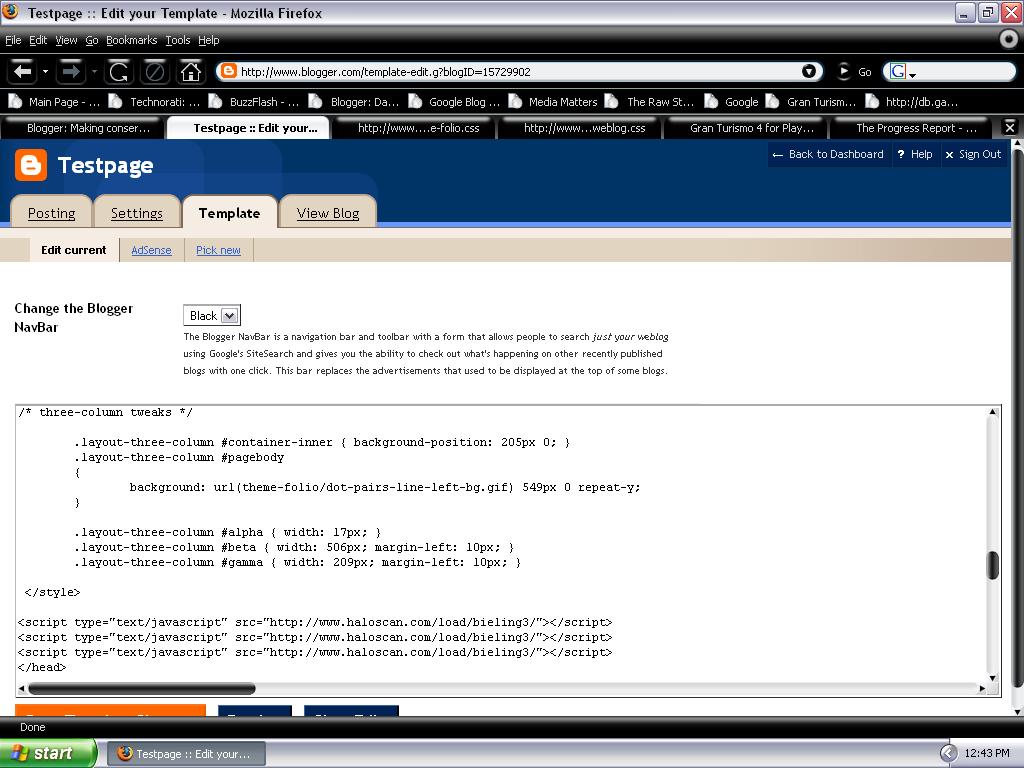
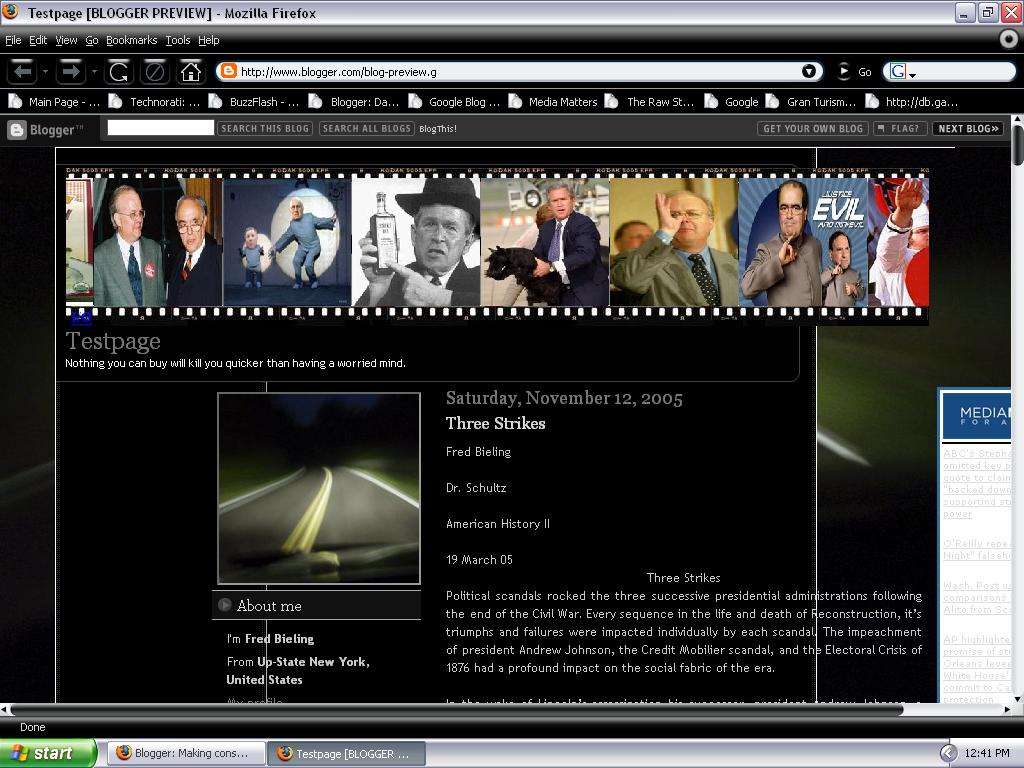
I've got pools of blood and code at me feet... please be patiant, the Doc is at work.-Update, this three column thing is kicking my ass...
12 January 2006
Fatwah #336

Disgraceful.
 I am very disappointed in Ted Kennedy. Not a day goes by that I don't deal with someone in the blogosphere's Logical Fallacies, and one of the most used is a Red Herring known as, "Guilt by Association."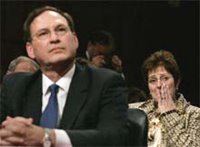
Sen. Lindsey Graham's (R-SC) performance has been no great service to the public either. I don't care about that soap opera shit. Why is it Republicans are already firmly behind Alito, don't they remember how they been burnt before with Souter, Kennedy, and even Ginsburg? What really needs to be focused on is clearing up the myths, the lies, and the half-truths. They are identified and debunked here by Media Matters:
#1: Alito's opinion in Farmer case is evidence that he would vote to uphold Roe
Broadcast and print media have repeatedly mischaracterized Alito's concurring opinion in the 2000 case Planned Parenthood of Central New Jersey v. Farmer as evidence that he has issued conflicting rulings on abortion. Specifically, these news outlets have juxtaposed Alito's decision in the Farmer case, in which he voted with the majority on the 3rd U.S. Circuit Court of Appeals to strike down a New Jersey law restricting certain late-term abortion procedures, with Alito's dissent in a 1991 case, Planned Parenthood of Southeastern Pennsylvania v. Casey, in which he argued for upholding restrictions on abortion. But Alito's actions in the two cases are in no way inconsistent. His concurring opinion in Farmer provides no support for the claim that he would have ruled the same way if he were sitting on the Supreme Court. Indeed, he explicitly noted in a separate concurring opinion that he was voting to strike down the abortion ban only because he was obligated as an appellate judge to follow Supreme Court precedent.
In that concurrence, Alito wrote that he was voting to strike down the abortion ban only because he was bound to follow the Supreme Court's 2000 decision in Stenberg v. Carhart. In that case, the court struck down a Nebraska law restricting certain late-term abortion procedures as an undue burden, in part because the ban did not include an exception for the health of the pregnant woman. While the majority opinion in Farmer provided a detailed examination of the New Jersey law's constitutionality, Alito explicitly distanced himself from such analysis. In his concurring opinion, he wrote: "Our responsibility as a lower court is to follow and apply controlling Supreme Court precedent." He went on to express the view that the court's only responsibility was to "explain why Carhart requires us to affirm the decision of the District Court." (The District Court overturned the New Jersey late-term abortion ban.)
As correspondent Jeffrey Toobin stated on the October 31 edition of CNN's American Morning, the Farmer opinion represented "a reluctant following of precedent" by Alito. Toobin also correctly noted that Alito would have "a lot more flexibility regarding precedent" as a Supreme Court justice.
#2: Alito's recusal pledge covered only a limited time frame
In reporting on Alito's refusal to recuse himself in two cases involving companies in which he owned stock, The New York Times has repeated without challenge Alito's claim that the pledge he made in 1990 to recuse himself in such cases was limited to "the initial period" after his confirmation. In fact, when Alito assured the Senate Judiciary Committee that he would recuse himself from cases involving companies in which he had a financial interest, he did not qualify the pledge in any way or suggest that it was time-limited.
In the questionnaire he submitted to the Senate during his 1990 confirmation, Alito made the unqualified promise to recuse himself from all cases involving companies tied to his "financial interests," such as Vanguard Group and Smith Barney:
I do not believe that conflicts of interest relating to my financial interests are likely to arise. I would, however, disqualify myself from any cases involving the Vanguard companies, the brokerage firm of Smith Barney, or the First Federal Savings & Loan of Rochester, New York.
Despite this pledge, Alito participated in a 2002 case involving the Vanguard Group in which Shantee Maharaj, widow of a holder of Vanguard funds, charged, according to a November 1, 2005, Washington Post article, "that the company had improperly seized some private accounts and blocked the owner's widow from obtaining the funds they contained." Alito joined in a ruling in favor of Vanguard, but the decision was withdrawn after Maharaj complained that Alito's participation in the case was improper. Further, Alito ruled on a 1996 case involving Smith Barney.
The Times has also presented as undisputed the claim that Alito was not required to recuse himself in those cases. In fact, the propriety of Alito's participation in those cases is very much in dispute. George Washington University constitutional law professor Mary Cheh has said that "even though these are broadly held funds ... if you are aware of the holdings, you should recuse yourself because you stand to benefit one way or the other." Others such as University of Pennsylvania law school professor Geoffrey C. Hazard Jr. argue that Alito had no obligation to recuse himself from these cases. But even Hazard has conceded that Alito's 1990 pledge to recuse himself is "a basis for mild criticism," given that Alito has since engaged in conduct that is apparently at odds with it.
#3: Alito is a "strict constructionist"
Shortly after Alito's nomination, NBC Today co-host Katie Couric parroted his supporters' claim that he is a "strict constructionist." Such characterizations of Alito's judicial temperament promote the false dichotomy -- advanced by conservatives in support of Bush's judicial nominees -- between strict constructionists (who, supporters claim, will "interpret the Constitution literally") and "judicial activists" (whom supporters describe as "legislating from the bench"). Couric's comments also suggest that Alito's judicial philosophy is not a matter of dispute. But whether Alito is a true "strict constructionist" -- if scholars can even agree on a definition -- and a practitioner of judicial restraint is an issue very much in dispute. Indeed, some legal experts contend that by one measure of "activism"-- a judge's inclination to strike down statutes passed by Congress -- Alito's record is, in fact, that of a judicial activist.
A recent study by Yale law professor Paul Gewirtz and Yale Law School graduate Chad Golder suggests that Supreme Court justices often labeled "strict constructionists" (i.e., justices who purport to discern and apply the true original meaning of constitutional provisions) are the real judicial activists. Gewirtz and Golder ranked the justices according to how often each voted to strike down a law passed by Congress. They found that justices Antonin Scalia and Clarence Thomas, often considered the two most conservative justices on the high court, ranked first and third, respectively, in frequency of votes striking down acts of Congress. While their analysis concerned only Supreme Court justices, George Washington University law professor and New Republic legal affairs editor Jeffrey Rosen recently analyzed Alito's efforts to restrict congressional authority and similarly determined that Alito is an "activist."
In a November 22, 2004, New Republic column, Rosen defined "conservative activists" as those "determined to use the courts to strike at the heart of the regulatory state"; Rosen included Alito in that group. As evidence, he cited Alito's "troubling" view on the limited scope of congressional authority under the Commerce Clause as described in his "dissent from a decision upholding the constitutionality of a federal law prohibiting the possession of machine guns." Rosen concluded that Alito's "lack of deference to Congress is unsettling."
Alito's colleagues on the bench have similarly criticized his apparent willingness to usurp congressional authority. For example, the majority opinion of the 3rd Circuit Court in the case United States v. Rybar also criticized Alito's dissenting view that Congress ought to be required to prove a link between regulation and interstate commerce in such cases. Third Circuit Chief Justice Dolores K. Sloviter wrote: "We know of no authority to support such a demand on Congress"; further, she noted that such a demand would require "Congress or the Executive to play Show and Tell with the federal courts at the peril of invalidation of a Congressional statute."
#4: Alito's 1985 criticism of Roe mirrors legal scholars' opinion that the decision was right but incorrectly reasoned
In his 1985 application for the position of assistant attorney general in the Reagan Justice Department, Alito wrote that he was "proud of his contributions in cases in which the government has argued in the Supreme Court ... that the Constitution does not protect a right to an abortion." Numerous conservative commentators have attempted to downplay Alito's stated position on abortion by likening it to the common argument put forth by some more liberal legal experts that the decision in Roe v. Wade was correct, but the court's reasoning was wrong. In fact, there is a clear difference between arguing that a constitutional right to an abortion does not exist and questioning the particular constitutional principles upon which the court relied in reaching its decision.
Those likening these arguments have often put forth as examples the criticism of Roe articulated by Supreme Court Justice Ruth Bader Ginsburg. Some also cite comments made by author and former Supreme Court clerk Edward Lazarus. But in contrast to Alito, both Ginsburg and Lazarus have clearly stated in their writings on the subject that they believe the Constitution protects a woman's right to an abortion.
Indeed, in a 1984 lecture, Ginsburg strongly criticized the basis for the court's affirmation of a constitutional right to an abortion. She argued that, while the Supreme Court was right to strike down the Texas law in question, it should have done so on the basis of the Constitution's equal protection clause, rather than on an unstated constitutional right to privacy. But Ginsburg affirmed her belief in a constitutional right to abortion during her 1993 confirmation hearings.
In an October 2002 column, Lazarus asserted that "[a]s a matter of constitutional interpretation and judicial method, Roe borders on the indefensible." But he went on to write, "I say this as someone utterly committed to the right to choose, as someone who believes such a right has grounding elsewhere in the Constitution instead of where Roe placed it."
#5: Alito's 1985 job application does not represent his "personal views"
Some media figures have further defended Alito's controversial 1985 job application by claiming that he was not expressing his "personal views" when he wrote that "the Constitution does not protect a right to an abortion." For example, on the November 14, 2005, edition of Fox News' Special Report, host Brit Hume asserted that "these were not personal views he was discussing," but rather "the legal arguments that he made as a lawyer in the Reagan Justice Department."
In fact, Alito made clear in the application that he "strongly" and "personally" believed in the legal arguments in question:
Most recently, it has been an honor and a source of personal satisfaction for me to serve in the office of the Solicitor General during President Reagan's administration and to help to advance legal positions in which I personally believe very strongly. I am particularly proud of my contributions in recent cases in which the government has argued in the Supreme Court that racial and ethnic quotas should not be allowed and that the Constitution does not protect the right to an abortion.
#6: The "Ginsburg precedent" should apply to the Democrats' handling of Alito
As occurred following the 2005 nomination of Chief Justice John G. Roberts Jr., reporters and conservative commentators have suggested that Senate Democrats should set aside ideological concerns in considering the Alito nomination because Senate Republicans did just that in their nearly unanimous 1993 confirmation of Ginsburg. This deceptive argument -- the so-called "Ginsburg precedent" -- was recently revived by NBC host Tim Russert and The 700 Club host Pat Robertson. The argument rests, however, on the false claim that Republicans confirmed Ginsburg despite her reputation as a liberal. In fact, she had established a largely moderate record during her 13 years on the U.S. Court of Appeals for the D.C. Circuit and was recommended to President Clinton by a senior Republican on the Senate Judiciary Committee.
Indeed, Ginsburg was considered "a consensus choice, pushed by Republicans and accepted by the president in large part because he didn't want to take on a big fight," as Ruth Marcus wrote in her November 15, 2005, Washington Post column. Sen. Orrin Hatch (R-UT) -- then the ranking Republican member of the Senate Judiciary Committee -- claimed credit in his autobiography, Square Peg: Confessions of a Citizen Senator (Basic Books, 2002), for suggesting Ginsburg as a Supreme Court nominee in 1993 after discouraging Clinton from nominating then-Secretary of the Interior Bruce Babbitt. Hatch even wrote of Ginsburg: "Not many people realize this, but her voting record at the appellate court was very similar to that of another subsequent Supreme Court Justice, Antonin Scalia" [Page 263]. This assessment of Ginsburg's reputation as a moderate judge was substantiated by a study of the 1987 appeals court that found Ginsburg had voted more consistently with Republican-appointed judges -- such as Kenneth W. Starr and Laurence H. Silberman -- than those appointed by Democrats.
11 January 2006
For Vonster:

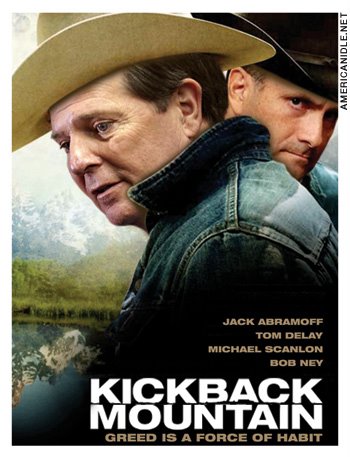
Poker Anyone?
 Credibility Gap
"I was an advocate seeking a job, it was a political job and that was 1985."
Q...and can you convince us that you're doing anything otherwise now? Is that your tell, rubbing your cheek like that?
Credibility Gap
"I was an advocate seeking a job, it was a political job and that was 1985."
Q...and can you convince us that you're doing anything otherwise now? Is that your tell, rubbing your cheek like that?
Media Matters Bulletin
Summary: For the second time in a week, nationally syndicated radio host Rush Limbaugh falsely claimed that the Foreign Intelligence Surveillance Court denied the FBI a warrant to search the laptop computer of Zacarias Moussaoui. But in fact, the FBI never petitioned the court for a warrant after bureau attorneys determined they did not have sufficient evidence.
-Put down the Kool-Aid,
stop carrying water!

Archives
August 2005 September 2005 October 2005 November 2005 December 2005 January 2006 February 2006 March 2006 April 2006 May 2006 June 2006
